If you have been comparing villages inside The Woodlands and pulled up a number for Indian Springs to size against your budget, that number depended entirely on which site you happened to be looking at. In the same general window this year, published figures for this one village have read $535,000, $659,000, $671,251, and $675,398. None of those are typos. They are four separate reads of the same roughly 2,200-home village, taken within months of each other.
That spread is not a data error to shrug off. It is what happens when a village this small changes hands one house at a time, and it should change how you use any single median when you sit down to actually price an offer here.
Five Sources, Five Numbers, Same Village
Line the recent reads up and the pattern gets clearer:
- One national portal's closed-sale tracking put the median sale price across all home types at $671,251, up 20.9 percent year over year, as of April 2026.
- A second portal's separate read, pulled around the same time, showed $659,000, a 3 percent year over year increase.
- A valuation-modeling site, updated in July 2026, priced the median home at $675,398 using broader estimation rather than closed sales alone.
- A flat-fee listing site, current as of November 2025 and already several months stale by comparison, priced the median at $535,000 and described prices as down about 6.3 percent year over year.
- On one afternoon in July 2026, a regional brokerage's live feed for the same village segment showed exactly one active listing, averaging $385,000, simply because that was the entire day's inventory.
That last one is the most honest number on the list, not because it is accurate, but because it shows its work. An average of one listing is not a market signal. It is a snapshot of whatever happened to be for sale that day.
A median built from a handful of closings is not really a price. It is a coin flip on which houses happened to close.
What's Actually Being Averaged
Indian Springs earns its name partly from terrain, but the housing stock underneath that terrain is doing most of the work on these numbers. The village runs from compact patio homes around 1,300 to 2,100 square feet, up through a large mid-size band around 2,200 to 3,300 square feet, and into a meaningful custom segment with homes over 4,100 square feet in neighborhoods like Lenox Hill, Bracebridge, and Shawnee Ridge.
That is not one market wearing one label. It is three markets stacked under a single village name. When a compact patio home in Rushwing or Sandpebble closes in the same month as a custom estate in Cascade Canyon or The Woodlands Reserve, the "median" for that month is describing an average of two different products, not a stable price for either one.
If you are comparing Indian Springs to a larger, more uniform village and treating both medians as equally trustworthy, you are giving Indian Springs' number more precision than the sample size can support.
The Street That Splits Who You Call
There is a second detail that matters more than any median once you have found a specific address, and it has nothing to do with price. Indian Springs is split between two separate covenant-enforcement bodies, with the dividing line running down Falconwing Drive.
| Side of Falconwing Drive | Governing Covenant Authority |
|---|---|
| East | WCA |
| West | TWA |
Two homes on the same street type, built by the same builder, a block apart, can fall under different review processes for the exact same kind of renovation depending on which side of that line they sit. If you are planning a pool, an addition, a fence, or any exterior change that requires prior approval, the first question is not what the rules say. It is which authority you are actually asking.
This is the kind of detail that never shows up in a portal's price history, but it is exactly the kind of thing that slows a renovation timeline by weeks if you assume the wrong process going in.
The Hills Aren't Just Scenery
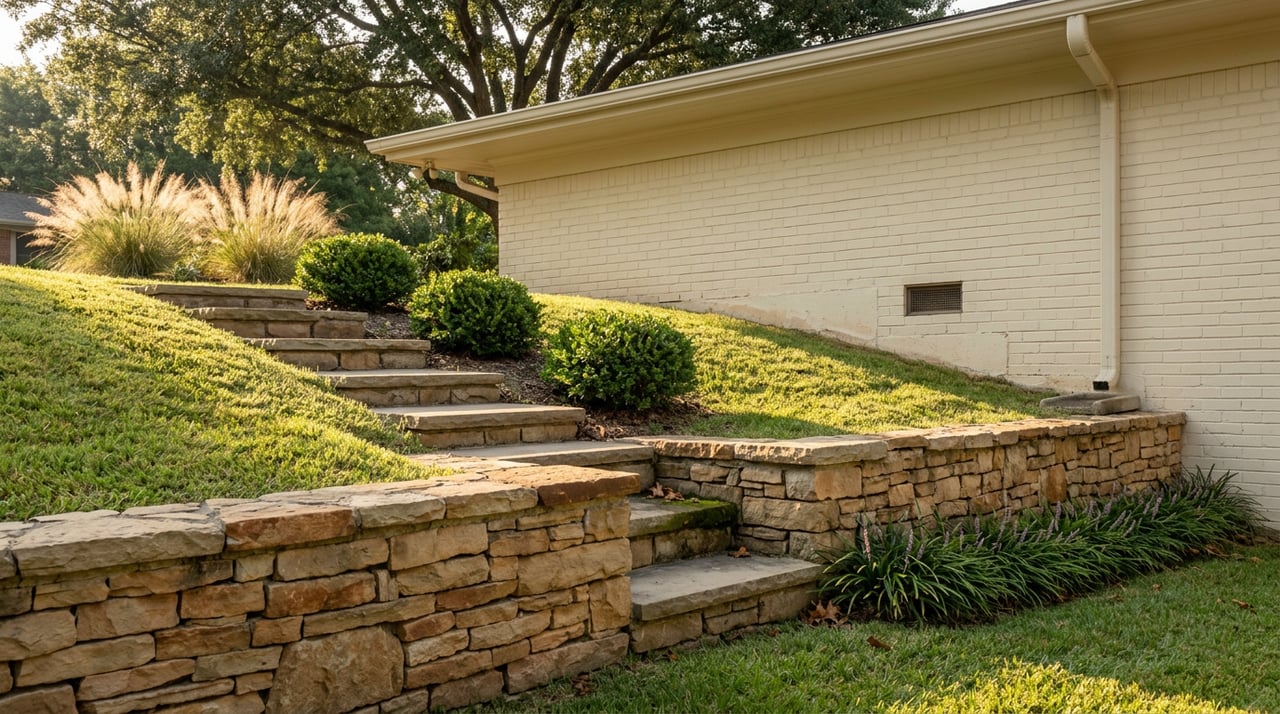
Indian Springs is the only village in The Woodlands with real rolling terrain and actual elevation change. That is part of the appeal, and it shows up in how homes are marketed here. It also shows up in the ground itself.
Soils in this part of Montgomery County tend to run as Conroe and Catahoula sand-clay mixes, which behave differently than the flatter Beaumont Formation clay found under most of the rest of The Woodlands. Builders working across the community have noted that geotech reports on these sloped lots often call for modified post-tensioned slabs with extra reinforcement at perimeter beams, a different and typically costlier foundation approach than what a flat lot in a neighboring village requires.
Custom construction across The Woodlands as a whole is running roughly $350 to $650 per square foot as of 2026, with the highest-spec work in enclaves like Carlton Woods sometimes exceeding $750 per square foot. Indian Springs custom lots are not priced at Carlton Woods levels, but the terrain that makes a hillside lot feel private and elevated is the same terrain that adds a real, separate engineering line item to a construction budget, one that buyers comparing lot prices across villages can easily miss if they are only looking at the price per acre.
What This Actually Means Before You Write An Offer
None of this means Indian Springs is unpredictable in a bad way. It means the published median is the wrong tool for the job of pricing a specific house. A few things matter more:
Ask for closed comps in the same size band as the home you are considering, not the village-wide median. A patio home should be compared to other patio homes, and a custom estate on a sloped lot should be compared to other custom estates on sloped lots, not blended together.
Confirm which covenant authority, WCA or TWA, governs the specific address before you assume what exterior changes will or will not require approval.
If you are building custom or buying an existing home on a visibly sloped lot, ask whether a geotechnical report already exists, and budget for the possibility that foundation work here costs more than it would on a flat lot elsewhere in the community.
Frequently Asked Questions
Why do median price figures for Indian Springs vary so much between sites? The village is small, with roughly 2,200 homes total, and its inventory ranges from compact patio homes to large custom estates. A monthly median calculated from a handful of closings shifts dramatically depending on which type of home happened to sell that month, and different sites also pull from different data sources and update on different schedules.
Does the Falconwing Drive covenant split affect what a home is worth? Not directly, but it affects the process for anyone planning exterior changes. Homes east and west of Falconwing Drive answer to different governing bodies for architectural review, so the timeline and requirements for a given renovation can differ from one side of the street to the other.
Do all homes in Indian Springs need special foundation work? No. The added foundation consideration applies mainly to sloped or hillside lots, where soil composition differs from the flatter parts of The Woodlands. A patio home on level ground in the village would not carry the same considerations as a custom build on a ravine lot.
If you are weighing Indian Springs against another Woodlands village and want the comps that actually apply to the specific size and lot type you are considering, that is exactly the kind of village-level reading The Brownstone Group does every day. Reach out and we will help you see past the headline number to the price that actually applies to your search.